
The future of machines is a design question, not a robot question.
From automatic sewing to knitwear built in one piece, from microfactories to 3D printing: what already works, what is still a promise, and what changes for anyone designing.
01 — A Half-Automated Factory
The factory of the future is often pictured as an empty hall, with robots in place of people. Today's factory is something else: automated in pieces, department by department.
Cutting, marker making, embroidery and many assembly operations already run on programmable machines. But automation is not spread evenly along the chain, and the point where it stops says more than the point it has reached.
The cutting room is the easiest to automate. A fabric laid flat on a table can be measured, recognized and cut along precise paths. The sewing room is another story: here the pieces must be gripped, lifted, oriented, overlapped and held in place while the needle works.
And fabric is not a rigid material. It bends, stretches, slips and puckers, and it changes behavior with composition, construction, weight and finishing. That is why a factory can have highly advanced cutting machines and still leave a large part of the sewing to skilled people.
02 — Sewing: The Hardest Step
Sewing means controlling, at the same moment, two flexible materials, the needle's path and the feed of the fabric. Many narrow operations have been automatic for a long time: buttonholes, buttons, repetitive seams, pocket setting, some assembly sequences. That is established industrial automation, but it is not a robot able to make any garment.
The next leap would be to have a robot handle the panels and bring them under the sewing head. To get there, someone chose an unusual route: make the fabric temporarily rigid, instead of teaching the robot to handle a limp one. The panels are stiffened with a polymer that dissolves in water, the robot assembles them as if they were sheets of card, then a wash removes the treatment. The idea is brilliant because it changes the material instead of asking the machine to adapt to everything. But it remains a technology in development, tested with a few partners, and not a machine you buy and switch on.
Another attempt aimed to bring automatic T-shirt lines close to consumer markets. The expectation of fast adoption did not come true: even an apparently simple jersey T-shirt has a variability that makes it hard to keep position, tension and path constant. They were not absolute failures, because they produced working systems and technical results. But a demonstration or specialized line is not a normal sewing line running a wide range.
There are at least four limits.
- Material variability: a compact cotton, a stretch jersey, a laminated technical fabric and a heavy denim behave very differently.
- Style changes: a robotic line must be reprogrammed, tooled and checked every time geometry, materials or assembly sequence change.
- Cost: the investment pays back only with enough volume, continuity and running time.
- Human work: machines do not remove operators. They shift skills towards programming, control, maintenance and handling anomalies.
The most concrete prospect is therefore not a robot that sews any garment. It is selective automation of repetitive operations, with people on the variable and more complex work.
03 — The Knit That Builds the Garment
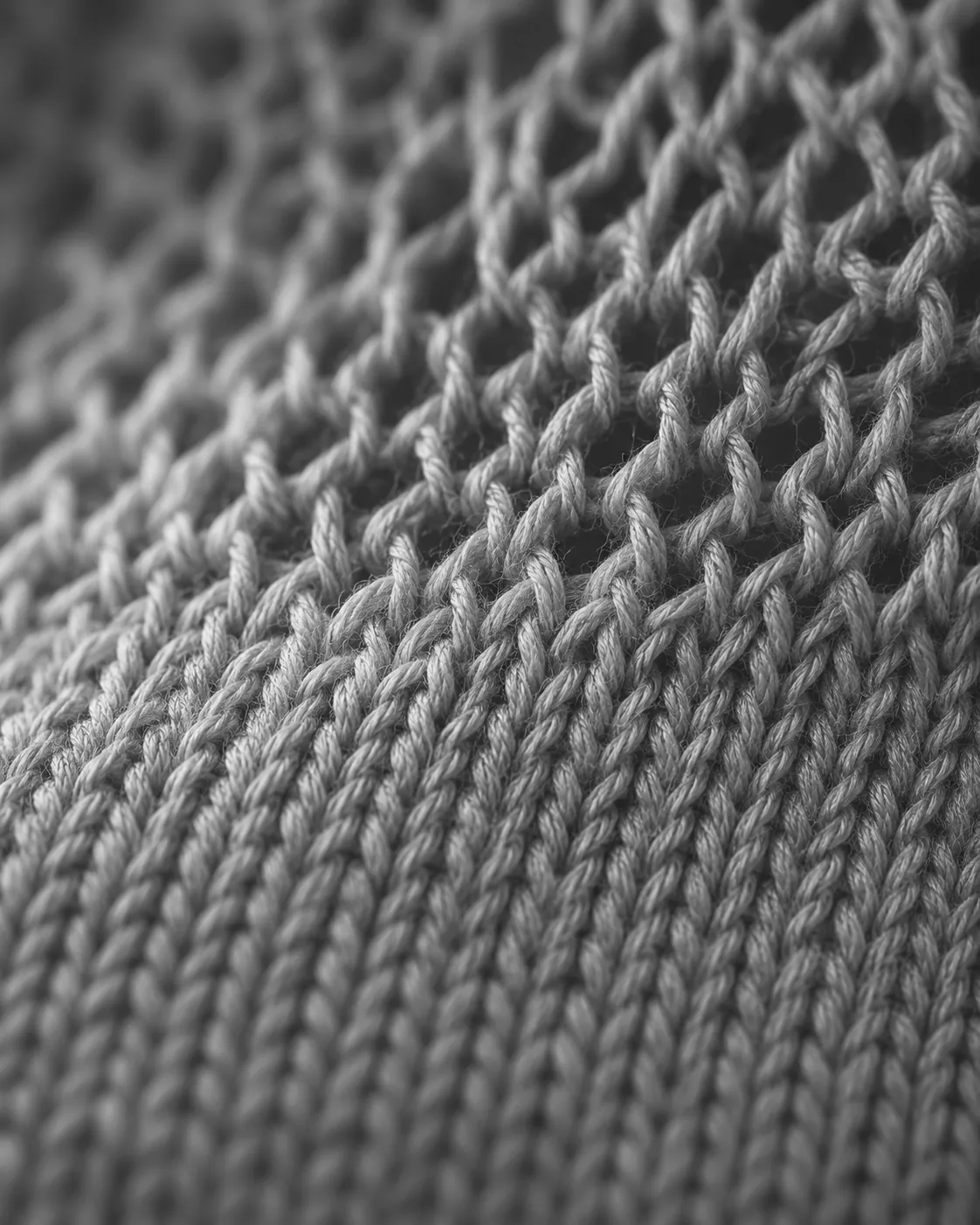
Knitwear is one of the fields where digital production has reached the most mature industrial results. In the mid-1990s a machine appeared that could build a three-dimensional garment directly from yarn, without cutting and sewing separate panels. Many generations have followed since, faster, finer and more flexible in construction.
Here the robot has nothing to handle, because the shape comes from programming the stitches. And this changes how a garment is designed: sleeves, body and neckline can be born in a continuous structure, with different characteristics in different zones. Assembly operations and cutting waste are reduced, and density, texture and function can be adjusted.
The machine, however, does not make the design easy. The pattern maker must understand how a garment's geometry becomes a knit structure: elasticity, recovery, yarn tension, drape and dimensional stability remain decisive variables.
Then there is on-demand production. Compact machines exist, designed to sit close to the point of sale and to personalize, so it is not only a forecast. But that does not mean every garment can be produced economically as a single piece: programming the machine, preparing the yarn, checking the sample and controlling measurements have costs and times that must be absorbed. The real advantage is flexibility: smaller lots, quick variants, fewer assembly steps. Not the one-off garment with no set-up cost.
04 — Cutting, Printing, Finishing and 3D Printing
Where automation is already concrete, it has been for a long time. In cutting, design systems drive the machines directly: they spread the layers, build the marker, cut with a controlled blade and separate the pieces. It is one of the most advanced departments in the whole of garment production.
Digital printing has also reached industrial level. It transfers designs and color variants straight onto the fabric, reduces dependence on screens and preparation in some applications, and favors short runs and more graphic variety. It has not, however, replaced traditional systems: speed, ink cost, fabric preparation and color fastness still guide the choice.
In finishing, the evolution is mostly towards tighter control of parameters and less difference from one lot to the next. But an automatic process is not, for that reason, a sustainable one: energy, water, chemicals and maintenance stay in the balance.
3D printing of fabrics and garments is a separate matter. It builds structures by depositing material instead of cutting and assembling surfaces, and it is interesting for three-dimensional forms, rigid or semi-rigid elements and functional components. But the problem is not printing a shape. It is obtaining a material with the right flexibility, strength, comfort and breathability to be worn by a person. Research is active and the gap between a prototype and repeatable production is still wide. Today it can sit alongside traditional textiles, not replace weaving, knitting or garment making.
05 — How Ready Each Technology Is
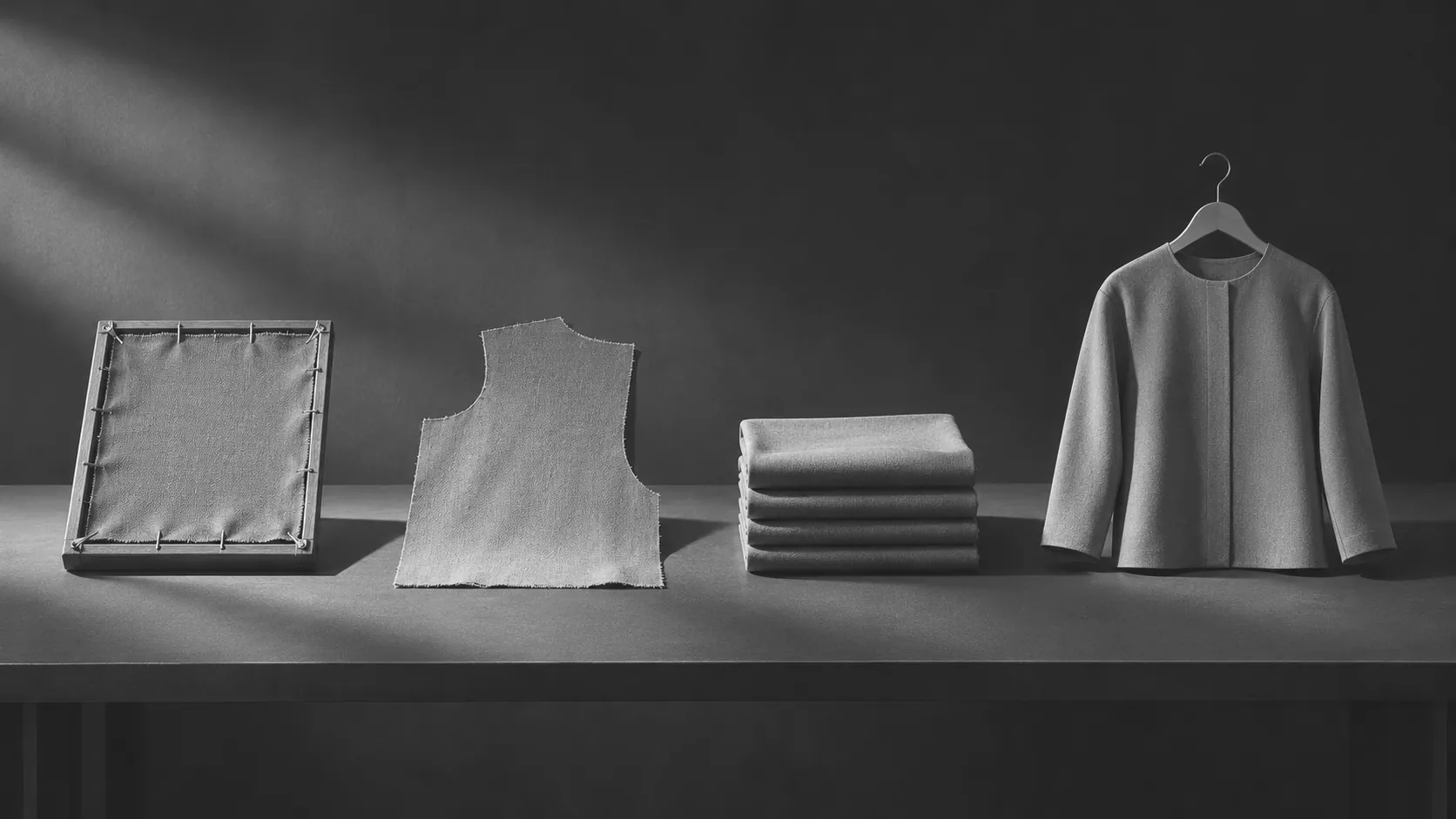
Not all these technologies are at the same point, and confusing them is the most common mistake. A machine that manages to do one thing is not, for that reason, able to sustain real production, with different materials, frequent style changes, controlled tolerances and competitive costs.
A four-step scale is enough to find your bearings.
- LaboratoryWorks under controlled conditions, in front of the people who built it. 3D printing of fabrics is still largely here.
- PrototypeWorks on a specific product or material, with selected partners. Robotic sewing with stiffened panels is at this point.
- Limited productionReally produces, but for narrow ranges and particular conditions. Automatic lines for simple garments and microfactories sit here.
- IndustrialAn ordinary tool of a real department. Automatic cutting, digital printing and whole-garment knitting are here.
The scale is not fixed. A technology can move up a step or stay still for years, and it can be industrial for one product and still experimental for another. It serves one purpose: when you read an announcement, always ask which step we are really on.

06 — Microfactories and Districts
A microfactory is a small unit that concentrates machines, skills and processes for flexible production and small lots. It is not necessarily a factory without people: it can be a workshop with digital machines, skilled operators and an organization able to switch quickly from one product to another. The studies that compare them distinguish at least two models: those oriented to innovation, more open and less automated, and those oriented to personalization, where automation weighs more.
Producing close to the selling market could change some of the chain's logic. Minimum order quantities could fall for repeatable products, without removing those of yarns, fabrics, dye houses and trims. Lead times could shorten, but they depend on materials and real capacity. Some processes could move closer to the markets without the whole chain moving: a product designed in Italy, made partly in a nearby country, finished in a specialized district.
In Italy the small factory should not replace the district. It could become one more node inside it, within a network of specialized units exchanging technical data. These are hypotheses, not results demonstrated at scale, and economists too urge caution: bringing some activities closer does not guarantee a proportional increase in jobs, because some tasks pass to machines. The future of the districts will not depend on labor cost alone, but on the ability to make machines, skills, materials, suppliers and response times work together.
07 — What Will Not Change
Part of production work will stay tied to a physical understanding of the product. A machine can execute a seam, but it must receive correct information about how the garment is built. It can cut a fabric with precision, but it cannot correct a wrong pattern, an unchecked fit or a material incompatible with the design.
Quality still depends on decisions made before production starts. Knowledge of materials, understanding of constructions, control of tolerances, assessment of fit and the ability to recognize a defect all remain important.
What changes is how these skills are applied. The product technician must understand not only how a garment is made, but also which technology suits its construction. The pattern maker must know the consequences of their choices on automatic processes, sewing paths, three-dimensional construction and tolerances. The technologist must make materials, machines, process parameters and quality control work together. Skill does not disappear: it moves from execution to the ability to govern more complex processes.
08 — What This Means for Anyone Designing Today
For anyone designing, the future of machines brings a responsibility that already exists: thinking about how a product is built before it reaches production. A designer does not need to know how to program an industrial machine. But they do need to know whether their design is compatible with the chosen process.
A garment conceived for whole-garment knitting needs a different design from one made of cut and sewn panels. A jacket with many manual operations cannot be judged by sewing time alone. A product for a microfactory must take into account the available materials, machine preparation and the lot size that holds up economically.
Four decisions become central.
- Construction must be consistent with the technology. It is not enough to move a traditional pattern onto a more advanced machine: you have to understand whether the product can be rethought to really use it.
- Variability must be designed. Materials, sizes, colors and components affect changeover times and repeatability.
- Cost must include the process. Fewer manual operations may mean more programming, tooling and investment. The advantage must be checked over the whole cycle.
- Documentation must be even more precise. Tech pack, bill of materials, measurements, tolerances and work sequences must carry the design between people, machines and production units without losing information.
This is where the physical level of production meets the digital level of Fashion Tech. The PLM organizes product information, the 3D model helps assess construction, the digital twin can link the representation to the behavior of a real process.
The production of the future will not necessarily be a factory without people. It will be a factory where people must better understand what machines can do, what they cannot, and how to organize work around those capabilities.
For anyone designing today, the question is not predicting which machine will replace human work. It is designing products that can be made in a conscious, efficient way, consistent with what production can really do.
It is machines, materials and people that turn that information into an object.
Knowing which technology is real is the easy part. Knowing which of it your product can actually use, and which would only add a cost, is the work.
Open — 1 of 3 client spots available. I work with a limited number of clients at a time, so every project gets real attention.
Talk through what your product can use →